
Let’s Talk About Squats Baby!


There is more than one way to cook an egg. So goes the same for squats. The squat is a functional and versatile way to strengthen some very important leg muscles. These include the hip extensors (Gluteus Maximus, Hamstrings and Adductor Magnus) and knee extensors (Quadriceps). Do your squats so that you can sit down and stand up, go up and down stairs, ski, surf, jump, and get down and up from the floor. And of course, having contoured and strong squat muscles help us feel better in our jeans and bathing suits.
Function first though, function first.

So, what’s the deal with squat rules? Toes out, toes straight, go lower, don’t go so low,let the knee go over the toes, never let the knee go over the toes. Let me share with you the modifiable parameters of the squat so that you can have a better understanding of different positions and methods for this exercise.
The Trunk
When the trunk is inclined forward the hip extensors have greater biomechanical force demands placed upon them. The more forward the trunk inclination, the more the force production or strength required out of the gluteus maximus and hamstring muscles. When the trunk is more upright, there is less demand on the hip extensors and more on the knee extensors.
Forward trunk inclination is achieved by hip flexion. If the hips are not able to flex enough, then forward inclination will eventually be accomplished by a posterior pelvic tilt and lumbar spine flexion.
The greater the forward trunk inclination, the more the back extensors will need to work to stabilize the trunk and resist spinal flexion.
Maintaining a neutral spine (no lumbar flexion, normal/slight lumbar extension, abdominals working) is very important in controlling loads and forces acting about the spine and trunk.

A: Forward inclination of the trunk with lack of hip joint flexion and spinal flexion. Not good and will lead to injury.
B: Forward inclination of the trunk via hip flexion with neutral spinal alignment. Good, efficient, loads on the spine are appropriately distributed and tolerated.
The Tibia
As the knee bends during a squat, the tibia (shin bone) will move forward into inclination just as the trunk can. The more forward the tibia is inclined, the greater the demands will be on the quadriceps.
Just remember that the more the knee flexes, the greater the pressure between your patella (knee cap) and femur bone.
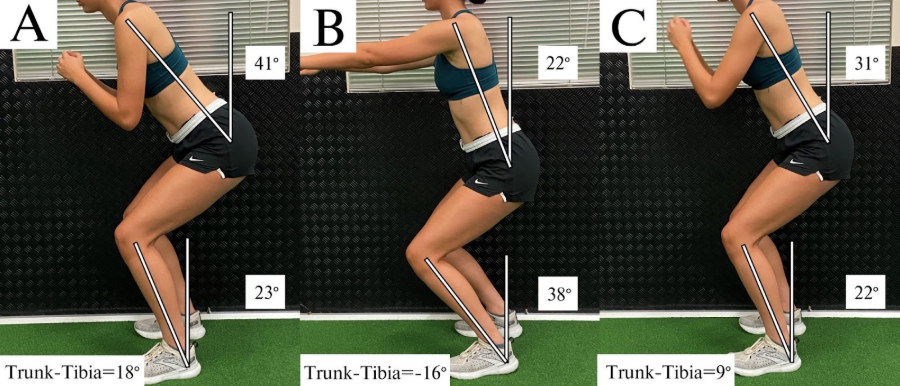
A: Greater trunk inclination shown-will ask the hip extensors to do more work than the quads.
B: Greater tibial inclination shown-will ask the quads to work more than the hip extensors.
C: More symmetrical trunk : tibia inclination- neutral/more symmetrical demand on quads and hip extensors.
Foot Rotation
Rotation at the foot is achieved from motion at the hip and a little from the knee itself.
Valgus forces that act upon the knee during a squat (knee moving inward, stretching on the medial meniscus and medial collateral ligament with compression of the lateral meniscus) can be reduced by 50% just by rotating the feet outward by about 30 degrees.
Stance Width
Considering the impact on knee valgus and demands upon the hips, the consensus is that a medium (100% to 150% shoulder width stance) is optimal. This medium stance also has a favorable impact on gluteus maximus muscle activity.
Squat Depth
Partial, half, deep. Each squat depth allows for biasing different muscle groups and accommodating different flexibility levels or painful conditions of the back, knees and hips.
Partial and half squats are generally safe for those with knee, hip or back pain when done with good spinal alignment, hip width or greater stance, forward trunk inclination and a slightly toed out position.
Deep squats are functional and can be therapeutic for the lower back, hips and ankles. Achieving a low squat position without a load is a great way to stretch body parts. Greater squat depth requires a significant amount of knee flexion, hip flexion, and ankle dorsiflexion range of motion.


If a body does not have enough hip flexion, the back/spine will end up compensating with flexion. With a load like weights or a barbell, injury to structures in the back is likely to occur at some point.
So, if you are wanting to do deep squats with or without a load, go gradually and make sure that your spine can stay neutral. Start without external loads. For stability, work on end range holding with good form.
With respect to optimal hip extensor muscle force production, there may not be any advantages to squat depths of more than 110 degrees to 135 degrees. Research findings on this vary as other studies report greater muscle power output and athletic performance with deeper squat training.

Knees Over Toes Myth- never say never
Your knees may very well move forward over the forefoot and toes at some point during a squat, especially with deeper squats. And, this is fine, assuming that you are doing your squats with good alignment and form. For example, as the images below show, leading into a squat with knee flexion alone is not going to feel so great and leads to an unbalanced position with the center of mass positioned more forward. A squat with both hip and knee flexion and with the center of mass positioned towards the back portion of the foot/heel allows for optimal body mechanics, joint motions and with force production demands placed upon the muscles we are wanting to strengthen with a squat.
Take home message:

Squats are an incredibly useful, functional, and worthwhile compound exercise. The
possibilities for how to customize your squats seems endless and I dare say, even with a painful body part, you can find a way to make it happen.
Don’t hesitate to analyze your own alignment or ask someone to give you feedback.
And, of course being the biased physical therapist that I am, consult with one of us if you need further help.
Because Dr. Jill Trato is a RiseUp member, she offers a free 30-minute evaluation to anyone from our community. Just mention RiseUp and she’ll take a look, give you personalized advice, and help you understand what might be causing your pain. Contact Jill here
About Dr. Jill Trato, PT, DPT, NCS: Dr. Jill has been in practice for over 21 years specializing in the differential diagnosis and treatment of balance, neurological, movement and vestibular disorders. In addition, Dr. Jill has completed residency training in Proprioceptive Neurologic Facilitation, extensive training in manual therapy for orthopedic conditions as well as fellowship coursework in the movement sciences applicable to the orthopedic and chronic pain populations.Dr. Jill's approach is whole person focused and efficient. And, she thoroughly enjoys just getting to know you as an individual.


Comments